7 Powerful Ways Canadian Businesses Can Stay Ahead of Competitors :
Digital Maturity Benchmarking:
Digital maturity benchmarking helps Canadian businesses evaluate technology adoption, automation, and customer experience to outperform competitors and accelerate digital transformation.
Digital Maturity Benchmarking: How Canadian Businesses Can Stay Ahead of Competitors
Table of Contents
What Is Digital Maturity Benchmarking?
Why Digital Maturity Matters for Canadian Businesses
The 4 Levels of Digital Maturity
5 Key Questions to Benchmark Your Digital Maturity
Steps to Improve Your Digital Maturity
How Eviena Technologies Helps Canadian Businesses
Conclusion
What Is Digital Maturity Benchmarking?
Digital maturity benchmarking is the process of evaluating how effectively a business uses digital technologies compared to competitors in the same industry.
For Canadian companies operating in an increasingly digital economy, digital maturity benchmarking helps identify gaps in technology adoption, automation, analytics, and customer experience.
Businesses that regularly benchmark their digital capabilities can:
Identify technology gaps
Improve operational efficiency
Enhance customer experience
Strengthen market competitiveness
In simple terms, digital maturity benchmarking provides a clear roadmap for organizations aiming to evolve from traditional operations into digitally driven enterprises.
For Canadian SMBs facing growing competition, this benchmarking process is critical for long-term success.
Why Digital Maturity Matters for Canadian Businesses
Canada’s business environment is rapidly transforming due to advancements in technology, customer expectations, and global competition.
Modern customers expect:
Fast digital services
Personalized experiences
Seamless online interactions
Mobile-friendly platforms
Businesses that ignore digital transformation risk falling behind competitors that leverage technology more effectively.
Risks of Low Digital Maturity
Companies that lack digital maturity often experience:
Inefficient manual workflows
Limited online visibility
Slow decision-making
Higher operational costs
Benefits of High Digital Maturity
Businesses that succeed in digital maturity benchmarking and improvement gain significant advantages:
Stronger operational efficiency
Data-driven decision making
Higher customer retention
Faster innovation
Better scalability
According to research by
https://www.mckinsey.com/capabilities/mckinsey-digital
companies with higher digital maturity significantly outperform competitors in revenue growth and operational performance.
For Canadian businesses, digital maturity is no longer optional — it is a strategic necessity.
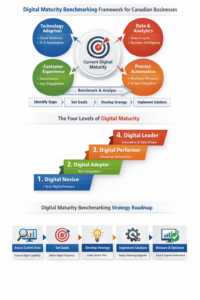
Digital maturity benchmarking strategy roadmap
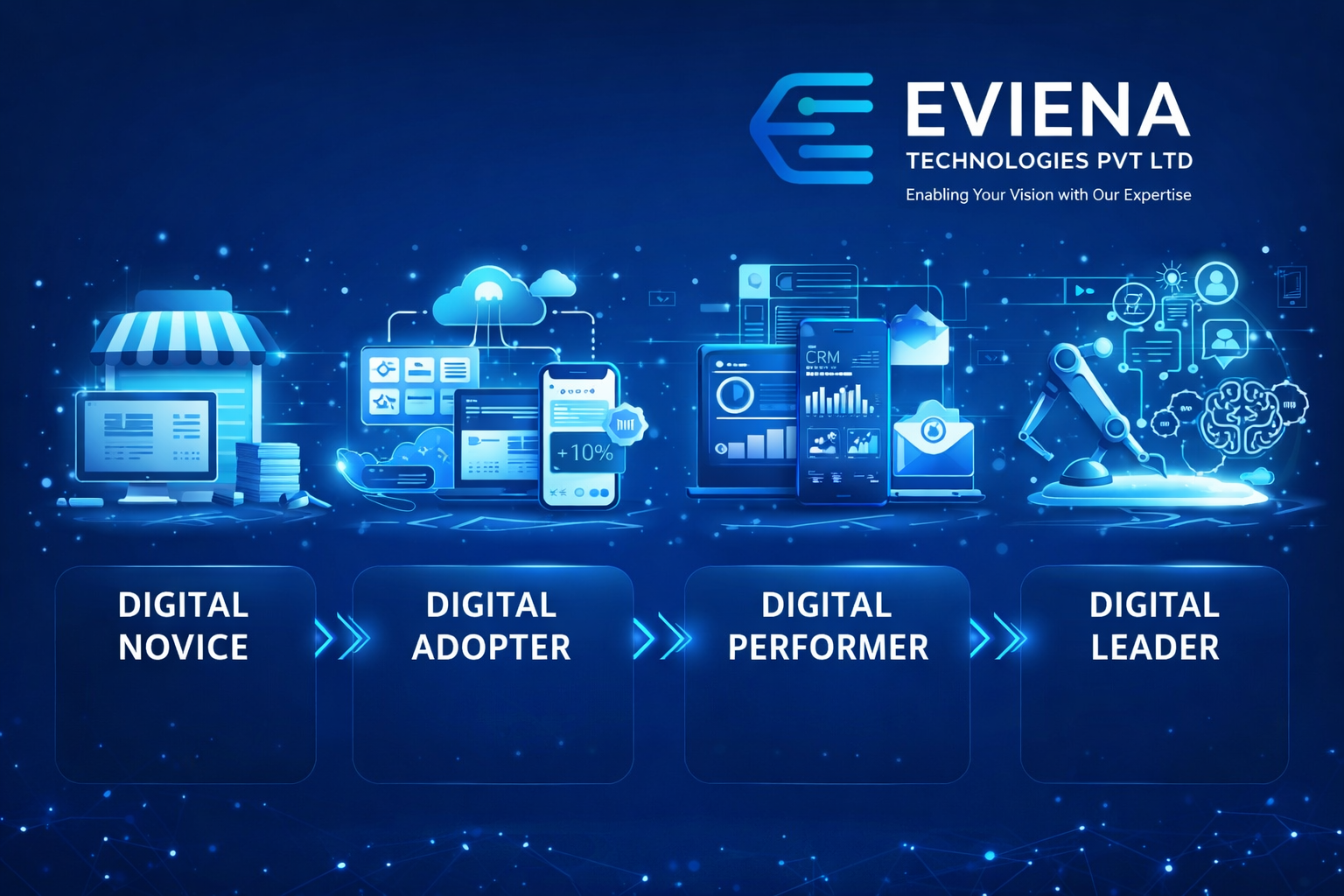
The 4 Levels of Digital Maturity
Understanding the stages of digital maturity allows companies to benchmark their progress and define a clear transformation strategy.
1. Digital Novice
Businesses at this stage have minimal digital adoption.
Characteristics
Basic website or no website
Manual workflows
Limited digital marketing
No defined digital strategy
Common Examples
Local retail stores, traditional service providers, or businesses just beginning their digital transformation journey.
Key Challenges
Inefficient operations
Limited online presence
Difficulty scaling business processes
2. Digital Adopter
Digital adopters have started integrating technology but systems are often fragmented.
Characteristics
Active social media presence
Cloud accounting or project tools
Basic e-commerce capability
Early digital marketing campaigns
Opportunities
At this stage, companies benefit greatly from system integration and improved analytics.
Businesses performing digital maturity benchmarking here often discover major efficiency opportunities.
3. Digital Performer
Digital performers actively leverage technology to improve efficiency and customer experience.
Characteristics
Integrated CRM systems
Marketing automation
Analytics dashboards
Mobile-optimized platforms
Advantages
Companies in this stage typically experience:
Improved operational performance
Better customer engagement
Faster business growth
These businesses use digital maturity benchmarking regularly to maintain competitive advantage.
4. Digital Leader
Digital leaders operate with a digital-first mindset, embedding technology across all operations.
Characteristics
AI-driven personalization
Predictive analytics
Fully automated workflows
Omnichannel customer experiences
Cloud-native infrastructure
Impact
Digital leaders consistently outperform competitors through innovation, agility, and superior customer experiences.
Many Canadian tech companies and digital-first brands fall into this category.
5 Key Questions to Benchmark Your Digital Maturity
To conduct effective digital maturity benchmarking, organizations should evaluate several critical factors.
1. How Advanced Is Your Technology Stack?
Businesses must assess whether their systems are integrated or disconnected.
Modern organizations rely on technologies such as:
CRM systems
Cloud platforms
Automation tools
Integrated project management systems
Disconnected systems often create inefficiencies and data silos.
2. Are You Using Data to Make Decisions?
Data-driven organizations make smarter and faster decisions.
Consider whether your company:
Tracks website analytics
Uses real-time dashboards
Analyzes customer behavior
Implements performance forecasting
Businesses ignoring analytics often miss valuable growth insights.
For example, platforms like
https://analytics.google.com/
help companies monitor user behavior and optimize marketing performance.
3. How Seamless Is Your Customer Experience?
Customers interact with businesses across multiple touchpoints.
Evaluate whether your company provides:
Mobile-friendly websites
Fast response support
Consistent digital and offline experiences
Smooth checkout or booking processes
Organizations with seamless experiences often achieve higher customer loyalty.
4. How Much of Your Operations Are Automated?
Automation is a strong indicator of digital maturity.
Businesses should assess:
Percentage of automated workflows
Automated marketing campaigns
CRM integration with sales processes
Automated inventory or order management
Automation reduces manual work and improves operational efficiency.
5. Do You Have a Clear Digital Strategy?
Technology adoption without a clear strategy rarely produces results.
An effective strategy should include:
Defined digital goals
Budget allocation for technology
Implementation timelines
Performance evaluation metrics
Organizations that prioritize digital maturity benchmarking alongside strategic planning achieve faster transformation.
Steps to Improve Your Digital Maturity
After benchmarking, businesses must implement practical improvements.
For Digital Novices and Adopters
Focus on building digital foundations.
Recommended actions include:
Launching a modern website
Implementing CRM systems
Investing in digital marketing
Tracking analytics performance
These foundational improvements significantly boost visibility and operational efficiency.
For Digital Performers
Businesses should focus on optimization and integration.
Key improvements include:
Marketing automation tools
Advanced analytics platforms
Customer personalization systems
Integrated internal systems
These upgrades enable scalable growth while maintaining operational efficiency.
For Emerging Digital Leaders
Companies nearing digital leadership should adopt advanced technologies.
Examples include:
Artificial intelligence solutions
Predictive analytics
IoT integrations
Custom enterprise software
These technologies drive innovation and create long-term competitive advantage.
How Eviena Technologies Helps Canadian Businesses
For many organizations, achieving digital maturity requires technical expertise and scalable development resources.
Eviena Technologies Pvt Ltd helps Canadian companies accelerate digital transformation through cost-effective technology solutions.
Our services include:
Custom software development
Cloud migration and infrastructure
CRM and ERP implementation
AI and automation solutions
Web and mobile app development
Digital transformation consulting
By partnering with a trusted offshore development provider, Canadian businesses gain access to:
Global technical expertise
Reduced development costs
Faster project delivery
Scalable technology solutions
🔗 Internal Resource:
Learn more about our Digital Transformation Services : https://evienatechnologies.in/custom-web-development/
Conclusion
Digital maturity benchmarking is an essential strategy for Canadian businesses navigating an increasingly competitive digital economy.
By understanding where they stand across the four maturity levels—Novice, Adopter, Performer, and Leader—organizations can identify the most impactful technology investments.
Businesses that prioritize digital maturity will be better positioned to:
Improve operational efficiency
Deliver superior customer experiences
Scale sustainably in a digital-first marketplace
For companies ready to accelerate their digital transformation journey, Eviena Technologies Pvt Ltd provides the expertise, technology, and strategic guidance needed to achieve lasting digital success.